Every brand wants to know what’s coming next, which products are starting to gain traction, which trends have staying power, and, maybe most importantly, which ones are worth actually investing in.
The challenge is that spotting momentum is a lot easier than interpreting it correctly.
We see this in our Landscapes data. One of the metrics we track is Product Momentum, which measures how much traction consumers believe different products are gaining or losing in the marketplace. In theory, finding the “next big thing” should be as simple as looking for the products with the highest scores.
In practice, that can lead you in the wrong direction pretty quickly.
1. Start by separating product momentum from category momentum
If we asked which product has the most momentum across everything we’ve measured, the answer would be robo-investing platforms. Thirty-eight percent of consumers say they have moderate to high momentum, putting them ahead of every product we measured across categories ranging from skincare to apparel.
The next two products on the list are centralized exchanges at 34% and traditional broker apps at 31%.
That’s when things start to look a little suspicious.
It’s possible that all three of these just happen to be among the hottest products in the entire marketplace. A more useful explanation, though, is that Trading Platforms is a high-momentum category overall. Consumers see a lot of movement happening in the space, which naturally pulls individual product scores higher along with it.
The opposite can happen in a category like Apparel Basics. Consumers may perceive less change across the category as a whole, so even the products that are generating significantly more momentum than their peers can end up with lower absolute scores.
Neither number is wrong. They’re just answering different questions.
If you want to understand how much momentum exists around a product in the broader marketplace, the raw score is useful. If you’re trying to decide where the most interesting innovation opportunity exists within your own category, you need more context.
2. Look for the products separating themselves from the pack
If raw momentum can be inflated by what’s happening across an entire category, the next step is figuring out which products are actually outperforming the pack. That’s where indexing becomes particularly helpful.
Rather than comparing a skincare product to a trading platform or a puffer vest to a robo-investing platform, we can compare each product to the average within its own category. That gives us a better sense of which products are generating an unusual amount of momentum relative to the alternatives around them.
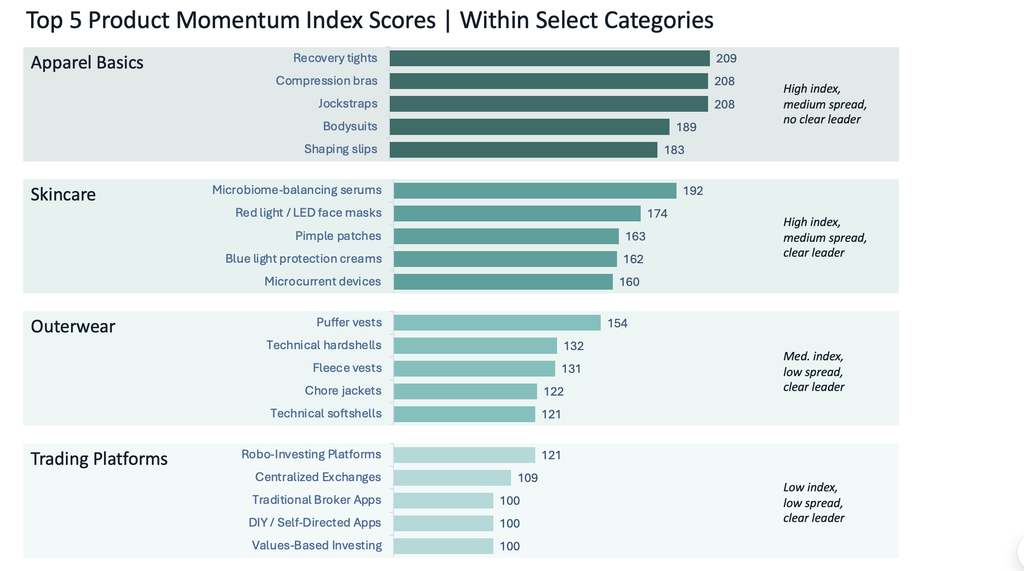
The difference is pretty striking.
In Apparel Basics, products like recovery tights, compression bras and jockstraps separate significantly from the category average. Trading Platforms looks almost like the reverse. There is plenty of momentum across the category, but less separation between the products at the top and everything else.
That distinction matters for a brand looking for its next growth opportunity. For example, a product with a lower absolute score but unusually high momentum within its category may represent more white space than a product sitting inside a category where everything is moving at once.
We see a similar story in Outerwear, where puffer vests stand notably ahead of products we measured. That doesn’t automatically mean an outerwear company should drop everything and launch its next puffer vest line. But it does mean there is a signal worth investigating, particularly if it lines up with the audience the brand is trying to reach.
And there are already some interesting examples in the market. Abercrombie, for instance, has expanded puffer vests into its YPB active line, with new versions built around wind and water resistance and positioned much more as an active lifestyle piece than a traditional cold-weather staple.
That doesn’t prove puffer vests are destined to become the next giant apparel trend. It does show why relative momentum can be useful. When consumer perception and brand activity start moving in the same direction, it gives you a reason to look closer.
3. The strongest opportunities often show up when you change the lens
Another reason trend prediction is difficult is that the answer can change depending on how you define momentum.
Most of the analysis above uses a top-two-box measure, combining consumers who say a product has moderate or high momentum. But if we tighten the lens and look only at consumers who say a product has high momentum, a slightly different set of products begins to emerge, including red light and LED face masks, bomber jackets and compression bras.
That smaller audience shouldn’t necessarily be viewed as a weakness. In some cases, it may point to a product that is earlier in its adoption curve or resonating particularly strongly with a more specific consumer group.
The broader point is that there isn’t one “right” way to look at momentum. Changing the lens can reveal different opportunities, especially when you start connecting those signals to the consumers your brand actually cares about.
4. Ask why the momentum exists in the first place
Even after you account for category context and audience, there is still an important piece missing.
A product can be gaining attention without solving anything particularly important for consumers. That may be enough to create a short-term trend, but it gives us less confidence that the opportunity has staying power.
This is where we can start layering Product Momentum with other parts of our Landscapes data, particularly Jobs-To-Be-Done (JTBD).
JTBD frames consumer needs around the things people are ultimately trying to accomplish through the products and brands they choose. The real value comes from looking beyond which jobs are most common and understanding which are most important, least satisfied, worth paying more for or particularly relevant to certain audiences.
Instead of simply identifying the products consumers believe are gaining traction, we can understand which high-momentum products also solve the needs that matter most to them.
That helps separate something that is merely buzzy from something that may have a stronger reason to grow.
So what products and trends would we put on our watchlist for 2027?
If we apply all of this thinking to the products showing the strongest relative momentum in our data, a few areas stand out as particularly interesting.
One way to see that is to bring the top-indexing products from each category into a single view. Putting them side by side makes it easier to see where the categories cluster together, where certain products separate from the pack and, ultimately, which signals may be worth watching more closely.
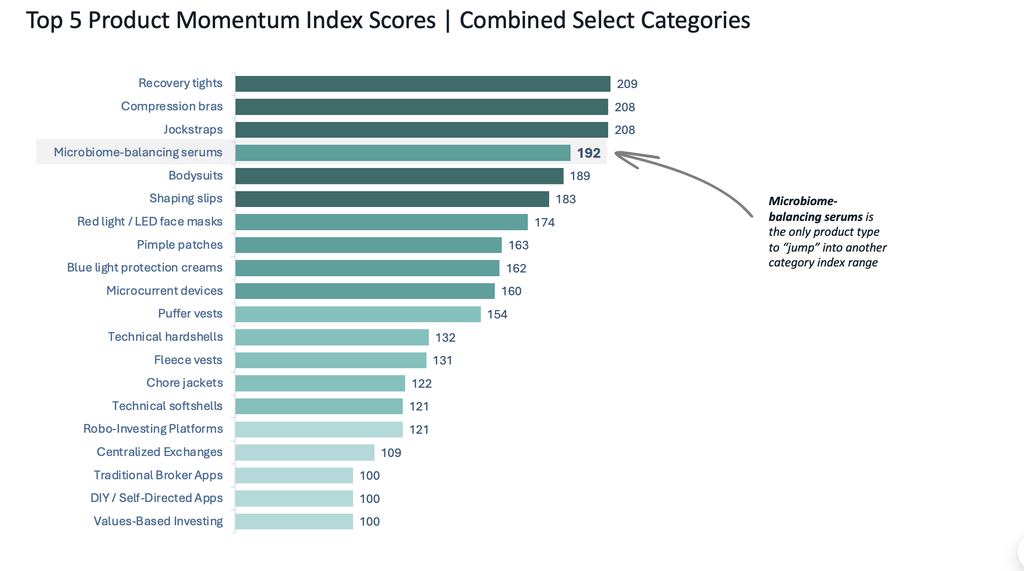
A few of those signals give us some interesting predictions for 2027.
Microbiome skincare moves mainstream
In the chart above, microbiome-balancing serums are the clear outlier within Skincare. With an index of 192, they separate significantly from the other skincare products we measured and start competing with some of the highest-indexing products in Apparel Basics.
And brands are already moving in that direction. Murad now sells a Biome-Balancing Clear & Prevent Acne Treatment Serum that connects microbiome support to a very familiar consumer problem, preventing and treating breakouts.
This suggests that microbiome science will increasingly become part of how brands solve needs consumers already understand, from acne and sensitivity to barrier health and healthier-looking skin.
Performance Basics Get More Specialized
We’d also watch increasingly specialized performance basics. Recovery tights and compression bras both stand out in Apparel Basics, and the broader direction makes sense. Consumers aren’t necessarily looking for more basics simply for the sake of having more choices. There may be an opportunity for basics that do something more specific.
Brands are already leaning into that territory. 2XU has dedicated recovery tights and newer versions incorporating features like far infrared technology alongside compression. ASICS has taken a similar approach with compression bras designed to combine targeted compression with ventilation, flexibility and posture support.
That makes us curious about where the category goes next. Recovery, support, temperature regulation, movement and other functional benefits could give brands new ways to differentiate products that have historically competed heavily on fit, fabric and style.
At-Home Beauty Tech Keeps Evolving
Finally, we wouldn’t write off at-home beauty tech yet. Red light and LED masks may already feel like an established trend, but strong momentum in our data combined with continued investment from major beauty brands suggests the format may still have room to evolve.
Lancôme, for example, unveiled a new LED face mask in 2026 and says its worldwide launch is planned for 2027.
The next opportunity may be less about launching yet another LED mask and more about making the technology easier to incorporate into an existing skincare routine, demonstrating clearer benefits or building products around more specific needs.
In other words, the next big product isn’t always a completely new invention. Sometimes the signal is telling you that consumers are ready for a familiar product to solve a different problem, serve a new audience or simply work better than what exists today.
That’s ultimately why predicting what comes next requires more than finding the biggest number in a dataset. Product Momentum can tell us where energy is building, but the better answer comes from understanding that momentum in context, seeing who is driving it and connecting it back to the needs consumers are actually trying to solve.
No single metric gives you a crystal ball. But put enough of the right signals together, and tomorrow’s opportunities start becoming a lot easier to see.
—————
Want to see what’s gaining momentum in your category?
Landscapes gives you an always-on view of your category, consumers and competitors, so you can spot emerging opportunities, understand what’s driving them and make your next move with confidence. Explore Landscapes →