One of the most encouraging things about TMRE this year was the direction of the conversations happening across the industry.
AI was still a major topic, of course. But alongside the excitement around new technology, we heard a renewed emphasis on the fundamentals that make research valuable, from rigorous methodology and reliable data to the ability to turn consumer understanding into meaningful business decisions.
There was also a growing focus on how insights teams can better enable their stakeholders, bridge the gap between research and marketing, and make consumer intelligence more accessible and actionable across their organizations.
While these conversations touched on different challenges and opportunities, they all pointed toward a common theme. The value of research lies not just in the answers it provides, but in what those answers make possible.
Here are a few of the biggest ideas we shared onstage, along with some of the broader themes our team took away from TMRE.
Thinking Bigger About Growth: Three Lessons From Newell Brands
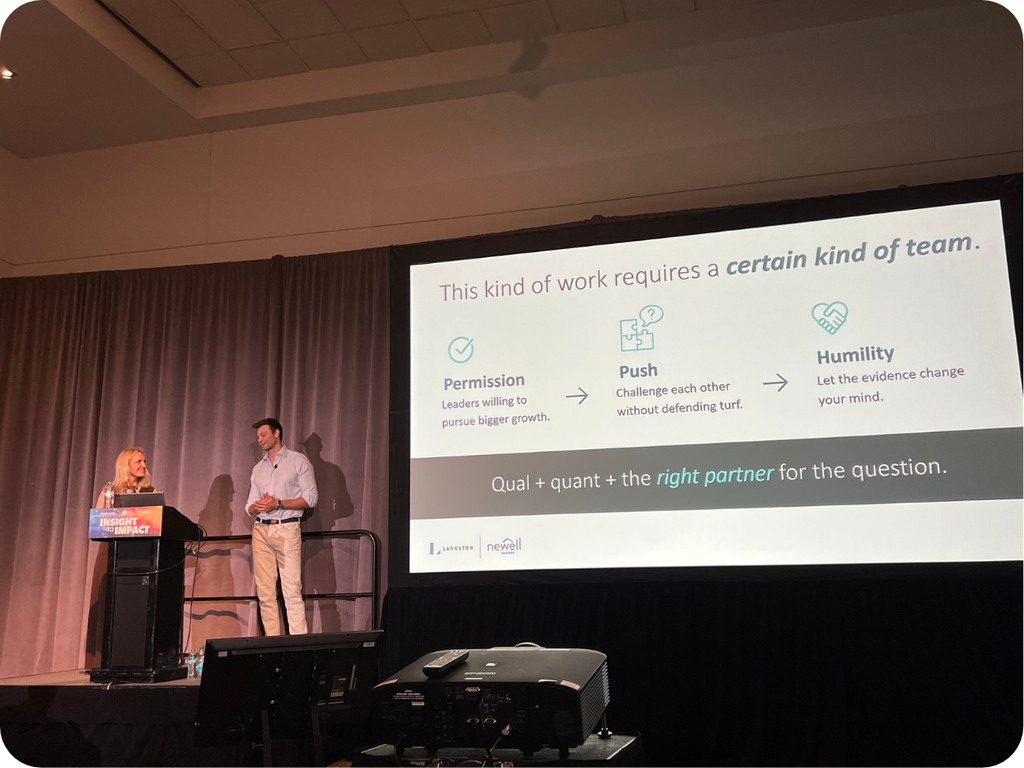
One of the highlights of TMRE was taking the stage with our partner Randee Keating, Senior Director of Insights at Newell Brands, to share how Langston’s consumer research helped the Sharpie and Parker brands uncover two very different opportunities for growth.
The session challenged insights leaders to think differently about where growth comes from. Rather than focusing solely on capturing market share from competitors, Randee and Tom Anderson, Partner and Co-Founder at Langston, explored how looking at consumers on the edges of and outside a category can reveal entirely new opportunities for growth.
While we can’t share all the details behind the research, here are three lessons from our research that we think are worth bringing back to your team.
1. Are you climbing the right hill?
Most brands spend considerable time figuring out how to compete more effectively within their existing markets. They study competitors, optimize positioning, identify underserved segments, and search for opportunities to capture incremental share.
And that work is important. But it can also create a blind spot.
Think of it as climbing a hill. You can invest enormous effort reaching the highest point of the hill you’re on, only to discover there’s a much taller mountain nearby.
In research, this is the difference between optimizing for a local maximum and searching for the global maximum. If your research is exclusively focused on understanding how to win within your existing category, you may never discover opportunities that exist beyond its current boundaries.
The question worth asking: Are we researching how to win more of today’s market, or are we also exploring what could make the market bigger?
2. Your most valuable consumers might be showing you what’s next.
Some of the most interesting growth opportunities emerge when you look closely at consumers who engage with a category in unexpected ways.
Your most engaged consumers can often reveal needs, behaviors, and motivations that aren’t yet widespread across the category. What might seem like a niche behavior today could signal a much larger opportunity tomorrow.
The key is looking beyond what these consumers buy to understand why they buy, how their needs differ from the broader market, and whether those differences point toward an opportunity to reach new audiences or create value in new ways.
The question worth asking: What are our most engaged consumers doing differently, and what might their behavior tell us about the future of our category?
3. Don’t forget to research the people who aren’t buying.
Another important limitation of traditional category research is that it often focuses exclusively on people who already participate in the market.
That makes sense when the objective is to understand existing customers and competitors. But what happens when the next wave of growth needs to come from people who aren’t buying into the category today?
These consumers are easy to overlook, yet they may hold some of the most valuable clues about future growth: What prevents them from participating? Do they see the category as irrelevant, inaccessible, or unnecessary? Are there unmet needs that existing products haven’t adequately addressed?
And perhaps most importantly, what would need to change to bring them into the market?
Answering those questions requires looking beyond current buyers and understanding the motivations, perceptions, and barriers of potential consumers.
The question worth asking: Who are we leaving out of our research, and what could we learn by bringing them into the conversation?
Beyond the Session: What Else We Heard at TMRE
The idea of thinking bigger wasn’t limited to conversations about category growth. Across the conference, we noticed several shifts in how insights professionals are thinking about their roles, their tools, and the impact of their work.
Insights leaders are becoming enablers, not just answer providers.
One of the strongest themes our team noticed was the growing emphasis on helping stakeholders use insights, rather than simply giving them access to information.
Making research available through a dashboard or platform solves one challenge. Helping stakeholders interpret the findings, develop a shared understanding of consumers, and apply those insights to business decisions is something else entirely. It requires the right technology, frameworks that create common language, and experienced partners who can help translate findings into action.
For insights leaders, the opportunity is to move beyond being the team that answers questions and become the team that enables better decisions across the organization.
AI is still dominating conversations, but research fundamentals are getting renewed attention.
AI was everywhere at TMRE, as expected. But what felt different this year was the growing emphasis on the qualities that make research reliable and useful in the first place.
Our team was encouraged to hear more conversations about methodology, defensibility, and bringing insights to life, alongside discussions about new technologies and capabilities.
Faster answers don’t automatically mean better answers. And making information more accessible doesn’t guarantee that people will interpret or use it appropriately.
As research technology continues to evolve, the fundamentals of sound methodology, high-quality data, and experienced human interpretation become increasingly important. The question is shifting from simply, “What can this technology do?” to “How can we use it to produce research that’s both trustworthy and impactful?”
The line between marketing and insights is getting blurrier.
The co-location of TMRE and Content Marketing World felt particularly fitting this year as we’re seeing marketing and consumer insights become increasingly interconnected.
Marketers need deeper consumer understanding to inform everything from positioning and innovation to messaging and customer experiences. Insights teams, meanwhile, are increasingly focused on making that understanding more accessible and actionable across their organizations.
We saw this firsthand in conversations at our booth. Among the many marketers we spoke with across travel, beauty, apparel, agencies and more, there was genuine excitement around the opportunity to access always-on, regularly refreshed consumer data through Landscapes. For many of these teams, consumer research hasn’t historically been something they’ve had access to, making the ability to explore their categories, understand consumer behaviors, and inform everyday decisions with reliable data an entirely new opportunity.
As the lines between these functions continue to blur, making reliable consumer intelligence accessible across an organization creates even greater opportunities to turn understanding into meaningful growth.
The Bigger Takeaway: Better Questions Lead to Bigger Opportunities
If there’s one idea we’re taking away from TMRE, it’s the importance of asking bigger questions, grounding our research in rigorous methodology, and turning consumer understanding into meaningful action.
Sometimes that means challenging the boundaries of a category. Sometimes it means looking more closely at consumers who behave differently. And sometimes it means bringing new perspectives into the research entirely.
As the insights industry continues to evolve, we believe the greatest opportunity is to empower insights leaders to uncover new possibilities, drive meaningful decisions, and lead their organizations forward with confidence. And that’s a conversation we’re excited to keep having.
Want to see the growth opportunities hiding in your own category? We’d love to help! Book some time to chat with us here >>