Welcome to Part 1 of Going Beyond Basic Insights, a five-part series exploring the methodologies and approaches Langston researchers use every day to transform consumer data into better business decisions.
Over the next five weeks, we’ll share the complete Langston approach to going beyond basic insights. You’ll learn how to find insights your competitors may miss, connect seemingly unrelated signals into richer strategic stories, add context to what consumers say, anticipate where markets are headed, and communicate findings in a way that drives action.
Want early access to the full Going Beyond Basic Insights guide now, instead of waiting for the next several installments? You can download the full five-step framework here and begin applying it to your research immediately.
Or read on to access the first installment, where we’ll show you how to find the insights your competitors may miss by looking past averages and top-ranked responses, separating category table stakes from true differentiators, and identifying what matters disproportionately to the consumers your brand needs to win.
Introduction
The Insights Paradox
Consumer insights research has never been more accessible. Survey platforms spin up in minutes. Qualitative panels are on demand. AI can synthesize hundreds of open-ended responses in seconds. The tools are faster, cheaper, and more abundant than ever before.
And yet, insights leaders across industries keep running into the same wall.
“I asked consumers a question, I got an answer… and it fell flat. Either they told us what we already knew, or the recommendation didn’t translate into anything the team could act on.”
This is the insights paradox of the modern era: more data, more access, and more speed, but still a persistent gap between what research delivers and what organizations actually need to move forward.
In an era where speed is increasingly expected, we believe the difference lies in how findings are analyzed, connected, and translated into direction for the business.
Too many insights practitioners stop at the surface, reporting the top-line numbers and flagging the most-selected attributes. While that work is necessary, it often leads to flat, expected insights that don’t influence decisions. It’s one of the main reasons insights leaders can deliver a great deal of information while still struggling to shape what the organization does next.
The proliferation of self-serve tools, quick-turn studies, and synthetic data has enabled insights professionals and other leaders to respond to a huge volume of questions from across their organizations. But the ability to respond is not always the same as the ability to lead through impactful, influential storytelling.
The insights professionals who create real organizational value understand how to read between the lines of consumer data, reconcile what surveys show with what category expertise knows, and translate complex findings into clear strategic direction.
In this step-by-step guide, we’ll share a few of the techniques our own team uses to push past surface-level insights and ensure that findings make a real impact on the organizations we build them for.
The ‘Average’ Consumer Will Lead You Astray
When a consumer survey comes back, the natural instinct is to look at the most-selected answers. Which attributes rose to the top? What are consumers telling us matters most? How much do shoppers spend on average?
This instinct is understandable and is a very reasonable place to begin any analysis, but it is truly just the beginning of the analysis. Nuanced, impactful findings almost always require us to double-click several more times.
The Table Stakes Trap
In almost every mature consumer category, the attributes that rank highest in surveys are the ones that every competitive brand is already delivering. They’re called table stakes for a reason: you need them to be in the game but delivering them alone won’t win you anything.
For example:
- Ask skincare shoppers what they want in a cleanser, and efficacy rises to the top.
- Ask apparel shoppers what matters, and comfort, fit, and feel dominate.
- Ask any category consumer and a battery of functional attributes leads the pack.
These are the things consumers have learned to expect from brands in each category, which also means they’re the most talked-about features and attributes among consumers, purchase influencers, and brand teams as well.
While brands need to check the boxes on these attributes to convert shoppers, be careful to avoid collapsing into the dialogue these core table stakes attributes motivate. They represent the floor, not the ceiling.
When insights practitioners present these top-ranked attributes as direction, they inadvertently lead their organizations toward the middle of the competitive pack. Your established competitors are already optimizing for those same signals. The result is convergence into a sea of sameness in which brands increasingly look, feel, and position the same, competing on marginal differences in execution rather than meaningful differentiation.
The Insights Treadmill
The Insights Treadmill is the cycle of constantly responding to questions from across the organization, often by running study after study and asking slightly different versions of the same thing. When the analysis stops at descriptive statistics and top-selected attributes, the findings tend to confirm what the category already knows. Teams stay busy producing answers, but have little opportunity to connect the dots, challenge assumptions, or influence what the business does next. The treadmill keeps moving, while insights remains stuck responding rather than leading.

The Index Score Advantage
The shift from basic to better insights can sometimes be as simple as one methodological move: augment your view of statistical averages by looking at indexes.
An index score measures how a specific audience segment responds to a question relative to the total population surveyed. An index of 100 means a group is responding at the average rate. An index of 150 means they’re 50% more likely to select that attribute than the average consumer. An index of 60 means they’re meaningfully less likely.
This reframes the entire analysis. Instead of asking “what do consumers care about?”, you’re asking “what does our target consumer care about disproportionately, and where do they diverge from the average?”
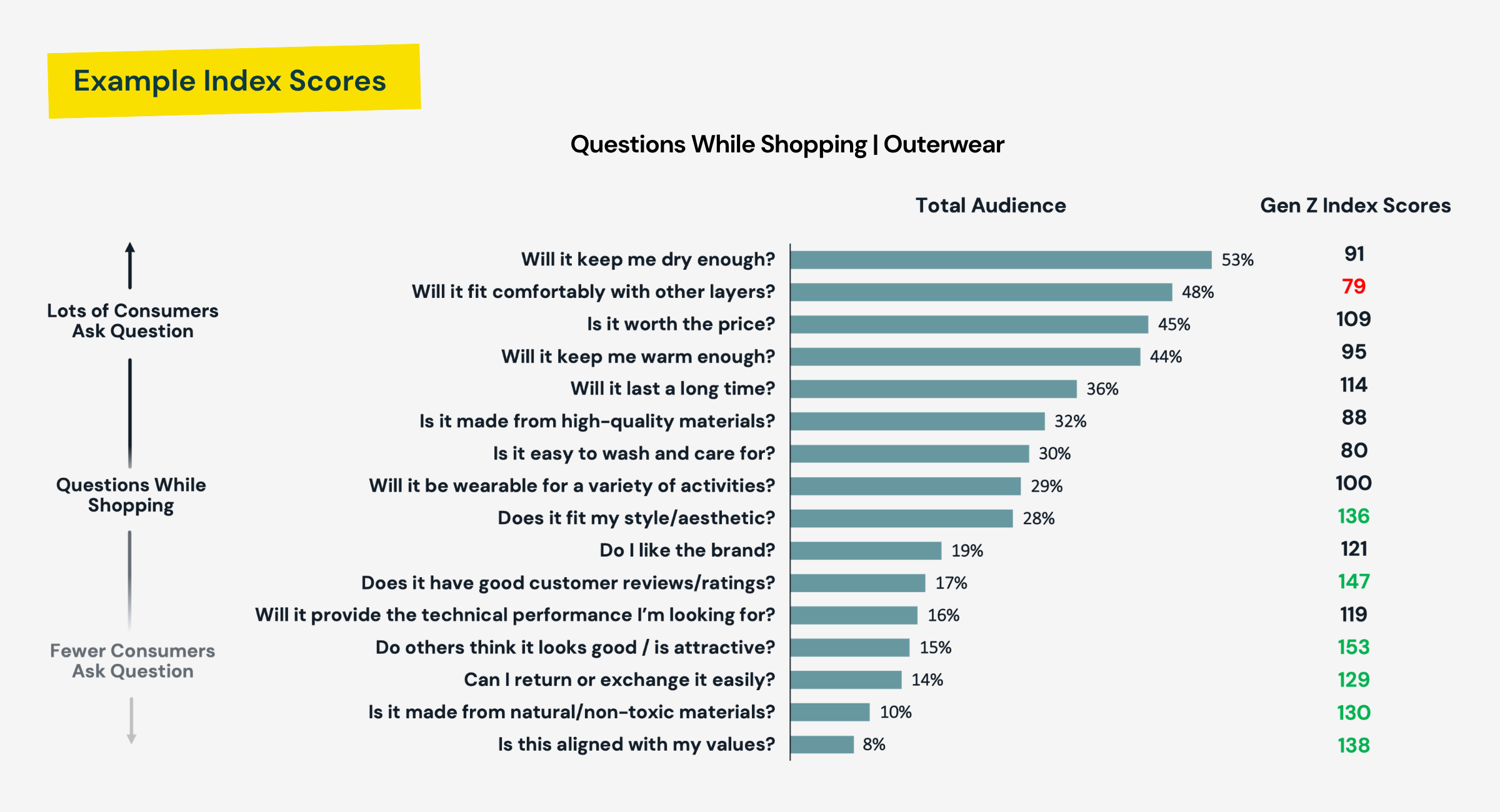
Consider a brand targeting Gen Z consumers purchasing outerwear. A standard frequency analysis might show that staying dry and fitting comfortably with other layers rank as the top two questions consumers ask, while style and aesthetics fall much further down the list. A surface reading says: focus on functional performance and don’t over-invest in design.
But index the data against the target segment, and the picture changes. Staying dry still matters, but Gen Z has an index of 91 on it, while fitting comfortably with other layers scores an index of 79. Meanwhile, whether an item fits their style or aesthetic scores an index of 136. The audience you’re actually trying to win is less focused on some of the category’s most common functional considerations than the average shopper, but they’re much more focused on style. Carving out a unique position of strength with this audience would therefore mean demonstrating a clear commitment to design across your product assortment.
The insight that only 28% of consumers ask whether an item fits their style or aesthetic starts to look very different when you know Gen Z is 36% more likely than the general population to ask it. Those few percentage points represent a real strategic signal and often a much larger commercial opportunity.
Why Index Scores Matter At Least As Much As Frequency
A consumer segment over-indexing on an attribute by 1.5x is telling you something fundamentally important about what drives decisions for that audience even if the absolute percentage appears small. Frequency alone can hide this signal where an index score surfaces it.
Important caveat: Absolute values do still matter, of course, and teeny-tiny numbers in absolute terms should not become huge parts of your analysis narrative. For example, we don’t recommend making a big deal about your audience’s 300 index on an attribute that’s selected by 1% of the total audience and 3% of your target audience.
How Market Maturity Changes the Game
This dynamic becomes especially powerful in mature, competitive categories.
In a nascent market (think: early consumer AI tools in 2024, first-generation smart devices in the 2000’s, new beverage categories in the 1990’s, and so on), table stakes attributes often are differentiators. When product quality varies dramatically across competitors, consumers actually do use functional attributes to make decisions, and delivering them better than the next brand creates real competitive advantage.
As categories mature and competitors converge, functional delivery becomes assumed. However, a giant leap forward in delivering table stakes can also shake up even a mature market.
An example we use often is the arrival of Yeti into the very mature cooler space. Before Yeti, every cooler brand knew consumers wanted to keep their food and beverages colder for longer. While it was important to deliver on, all brands were building products with roughly the same technologies, so they leaned into other attributes to differentiate transportation, design, etc.
But when Yeti arrived, it overengineered insulation so aggressively, at such a dramatically higher price point, that it redefined the category ceiling.
After Yeti, ice retention was still a baseline expectation, but the level of that baseline was substantially higher. As brands rose to meet it, they competed with renewed vigor, finding new ways to compete on design, identity, status, and community.
The same pattern plays out across many categories: apparel brands competing on technical performance before lifestyle and aesthetic differentiation took over. Athletic footwear competing on cushioning and support before storytelling and cultural cachet became the real battleground. In each case, the brands that kept optimizing the old table stakes, the ones that still ranked at the top of consumer surveys, found themselves converging toward a crowded middle.
The key bottom line of this dynamic is that, in mature categories, the most strategically valuable signals almost always live further down the ranked list than the top 3 most selected product attributes. Differentiation is revealed at the fringes rather than at the top of the list because that’s where differentiation lives.
This all might sound a little basic and a little obvious, but we’re constantly astonished to see brand after brand chasing table stakes attributes and wondering why they don’t have a differentiated identity in consumers’ minds. Many brands and insights leaders fall into this trap, and we’ve seen substantial brands start their renaissance simply by shifting from the top attributes, which help them keep up, to the differentiated attributes where they can stand out.
Conclusion
The most obvious insight is often the easiest one to find, defend, and present. But it’s also the one your competitors are most likely to discover.
Finding meaningful competitive advantage requires looking beyond what everyone in the category values and asking a different question: What matters disproportionately to the consumers we need to win?
When you begin separating table stakes from true differentiators, research shifts from describing a category to revealing where opportunity exists.
In Part 2, we build on this foundation by exploring how seemingly unrelated findings become far more valuable when they’re connected into a larger strategic story. Read it now >>
Don’t want to wait for the next installment?
Get early access to the full Going Beyond Basic Insights guide and learn the complete five-step approach Langston researchers use to transform consumer data into better business decisions.
Inside you’ll learn how to:
- Find insights your competitors may miss
- Connect findings into richer strategic stories
- Add context to what consumers say
- Anticipate change before your competitors
- Communicate insights that drive action